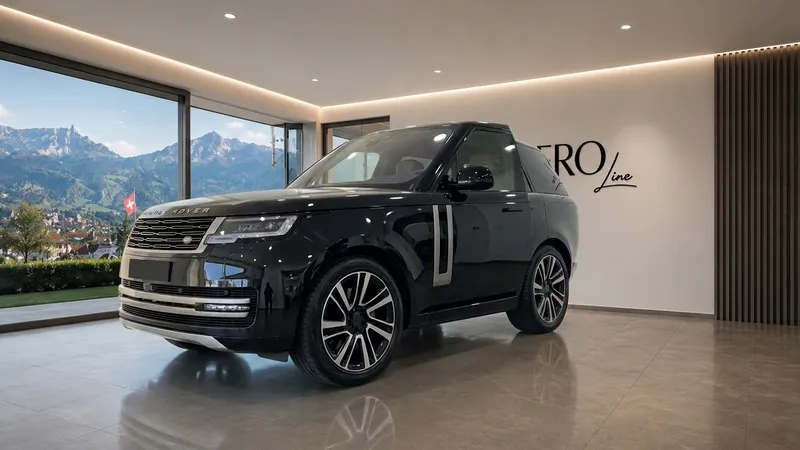
Luxury Car Rental in Switzerland in Winter: Tyres, Chains and 4x4s
Table of Contents
“Four-wheel drive” and “winter-ready” are not synonyms. A luxury SUV on unsuitable tyres can be the wrong car for an alpine road, while an all-wheel-drive performance car on the correct winter setup may be perfectly usable on a clear, treated route. The right Swiss winter rental is the exact vehicle whose tyres, clearance, luggage capacity and chain compatibility fit the exact journey.
Nero Line's Swiss fleet is concentrated in Zurich. Use the Switzerland hub, Swiss fleet page and Zurich collection to see the live catalogue, then ask the concierge to confirm the winter equipment of the individual car. A model name or listing photograph is not proof of its current tyres.
What Swiss rules actually say about winter tyres
Switzerland does not impose a single calendar date on which every passenger car must wear winter tyres. That narrow fact is often repeated without the more important part: the driver is responsible for a roadworthy vehicle that can be controlled without endangering or obstructing others.
The Swiss Federal Roads Office (FEDRO/ASTRA) says winter-suitable tyres are indispensable for safe cold-season driving. The legal minimum tread depth is 1.6 mm, while the authority recommends at least 4 mm for winter-suitable tyres because useful snow and slush performance declines earlier.
In practical rental terms:
- ask for written confirmation that the allocated car is on winter-suitable tyres;
- do not accept “AWD” as the answer to a tyre question;
- recheck the forecast and road report on the collection day;
- be prepared to delay, reroute or leave the car parked when conditions exceed the setup.
This is an operational guide, not legal advice. Current signs, police directions, the vehicle's equipment limits and the signed rental agreement take priority.
When snow chains become mandatory
Swiss sign 2.48 means snow chains are compulsory on the signed section. The obligation is route-specific and condition-specific, not a blanket rule for the whole country. Four-wheel drive does not turn a mandatory sign into a suggestion.
Before accepting a car for an alpine route, confirm all four of these points:
- correctly sized chains or an approved equivalent are supplied when the route may require them;
- the allocated wheel-and-tyre combination permits their use;
- you know which driven wheels they must be fitted to;
- the rental agreement does not prohibit fitting them to that vehicle.
This is where large performance wheels can undermine an otherwise capable SUV or supercar. Limited clearance inside the wheel arch may make conventional chains unsuitable. The solution is to allocate compatible equipment or choose a different vehicle, not to carry chains that cannot safely be fitted.
The Swiss motorway vignette
Passenger cars using Swiss motorways and autostrassen need a valid motorway vignette. A Swiss-based rental would normally be expected to carry one, but confirm it at handover rather than assuming. The Swiss government's vignette page explains the roads covered and the official sticker and electronic forms.
The vignette solves road access, not winter suitability. It says nothing about tyres, chains, insurance, cross-border permission or whether a pass is open.
Choosing the vehicle by route and weather
Performance SUV or G-Class-type 4x4
This is the strongest general brief for ski bags, several passengers, fresh snow and imperfect access roads. G-Class, Urus, Cullinan and comparable performance-SUV families offer useful space or clearance in different proportions. Compare the individual car, not the category label: a Cullinan's luggage arrangement, a G-Class roof height and an Urus wheel setup create different constraints.
Best suited to:
- airport-to-resort trips with bulky winter luggage;
- itineraries that move between several resorts;
- accommodation reached by a maintained but steep local road;
- days when ground clearance matters as much as traction.
Still verify: winter tyres, chain compatibility, ski carriage, garage height, child seats and roadside-assistance procedure.
All-wheel-drive GT or supercar
This can be an excellent autumn or clear-road winter choice. It is most convincing for Zurich, lakeside routes and an alpine journey with a stable forecast and maintained surfaces. It becomes less convincing with fresh accumulation, rutted snow, a steep chalet access or a chain requirement the wheel setup cannot meet.
Ask about front-axle lift, tyre type, wheel size, boot opening and ground clearance. “All-wheel drive” helps distribute drive torque; braking and lateral grip still depend heavily on tyres and speed.
Low or rear-wheel-drive supercar
Treat this as a weather-dependent experience, not an all-conditions resort transfer. It may suit a dry, cold day on clear roads. It is the wrong promise for an inflexible booking that must climb through active snowfall. Build in a substitution or chauffeur fallback before the trip, when it is easy to make the decision.
Resort-specific realities
Verbier
Verbier's official guide tells drivers to check current conditions and warns that chains may be required between Le Châble and Verbier during heavy snowfall. Parking at Le Châble can be more practical than taking a large car higher for a day on the slopes.
St. Moritz
St. Moritz can be reached over open pass roads or by loading the car onto the Vereina train between Selfranga and Sagliains. The car train can avoid an alpine pass, but it still has a timetable, queues and vehicle limits. Read the Zurich-to-St. Moritz winter guide before choosing a low car for the Engadin.
Zermatt
Ordinary visitor cars stop in Täsch because Zermatt is car-free. Clearance and traction matter on the road to Täsch, but the vehicle then becomes parked luggage rather than resort transport. A chauffeur plus onward rail or local taxi can be the more coherent luxury choice; see the Geneva Airport resort-transfer guide.
Gstaad
Gstaad is accessible by car and useful as a base for the surrounding Saanenland villages. Confirm the accommodation's parking and height limit. A roof box on a large SUV can be more restrictive in a covered hotel garage than the road itself.
Questions to ask before paying
Use a vehicle-specific checklist:
- What exact car will be supplied?
- What tyres are fitted now, and are they winter-suitable?
- What is the current tread depth?
- Are snow chains supplied, compatible and allowed?
- Are skis carried inside, through-load, on a rack or in a roof box?
- What are the roof-box and garage-height implications?
- Is the planned destination and route allowed by the rental agreement?
- Is cross-border driving planned, and is it authorised?
- Who provides roadside assistance, and what should the driver do after a closure?
- Can the booking switch to a more suitable car or chauffeur if the forecast changes?
Get the important answers into the booking record. Winter equipment should never depend on a phone conversation nobody can retrieve at handover.
Frequently asked questions
Are winter tyres legally mandatory in Switzerland?
There is no blanket calendar-based requirement for passenger cars. The driver must still operate a safe, roadworthy vehicle and can face consequences after causing an accident or major obstruction on unsuitable tyres. FEDRO strongly recommends winter-suitable tyres and at least 4 mm of tread for them.
Does four-wheel drive mean I do not need snow chains?
No. When the snow-chain sign applies, the signed requirement governs the section. The allocated car must also be able to accept the correct chain or approved device. Confirm compatibility before leaving Zurich.
Can I rent a supercar for a Swiss ski trip?
Yes, when the exact car, tyres, clearance, luggage and route fit the forecast. An all-wheel-drive performance car on winter-suitable tyres can work on open, treated roads. A performance SUV is usually the more resilient choice for active snowfall, bulky equipment and steep local access; a chauffeur is the fallback when neither is sensible.
Browse the Zurich-based cars available for Switzerland and ask for a written winter-equipment confirmation for the exact unit and dates.
Ready to drive Switzerland?
Pick your car and your dates. We handle the delivery. The Swiss line is +41 43 505 10 48.