Chartering a Crewed Yacht in Menorca or Alicante: What Your Rate Covers
Table of Contents
A crewed charter from Menorca or Alicante is chosen on guests, cabins and dates before rate. Nero Line arranges motor yachts, sailing yachts, catamarans and superyachts for charter across the Spanish Mediterranean. As of November 2026, day charters start from €750 for a catamaran, motor yachts from €2000 per day and superyachts from €6500 per day, with crew and standard port fees included and fuel charged separately. Pick the yacht that sleeps and seats your whole group.
Where can you charter a crewed yacht in Menorca or Alicante?
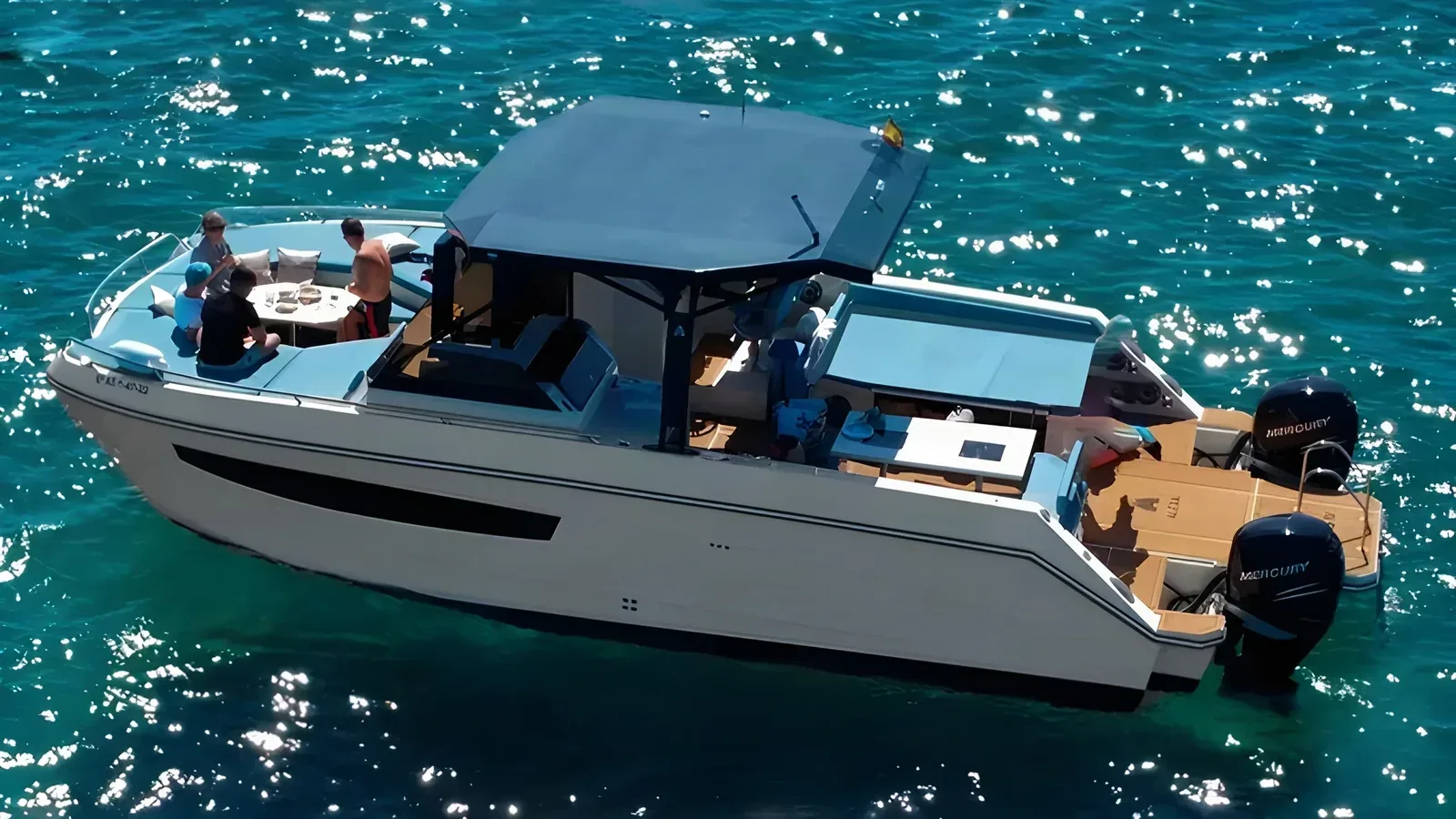
Crewed charters run across the Spanish Mediterranean, where motor yachts, sailing yachts, catamarans and superyachts are arranged and the yacht, the crew and the route are matched to your plan. Among the current listings, the Astilux Alexa 37 is a catamaran based in Alicante that takes 12 guests in 2 cabins.
Set the guest count and the number of cabins the group will accept before you start comparing rates. Twelve friends out for a single day and six people sleeping aboard for five nights are two different plans, even when the same hull can serve both.
For a Menorca start, name the port you want to board in and the days you have free, then ask which yachts can be positioned there for that window. Where a hull lies today is not a commitment about next August, so treat the base as something to agree rather than something to assume. The same question applies in reverse when flights land in Alicante and the group would rather finish the week somewhere other than where it started.
Treat the two ends of the charter as separate problems. Keep the first evening close to the base, since arrival day goes on flights and the move from the airport to the berth. Departure day is the one to protect, so plan to be back at the base the night before anyone flies, not on the morning itself.
Those options sit on Nero Line's Spain yacht charter service page.
Day charter or a week on board: which fits your dates?
We would price three to seven consecutive days with nights aboard as a week on board, and one or two days on the water with hotel nights ashore as a day charter. As of November 2026, the Alicante-based Astilux Alexa 37 is listed at €1900 per day among the current listings.
| Charter format | Day rate from | What the rate covers | Fuel and running costs |
|---|---|---|---|
| Day charter, catamaran | From €750 per day | Crew and standard port fees | Fuel charged separately |
| Day charter, motor yacht | From €2000 per day | Professional crew and port fees | Fuel charged separately |
| Week on board, MYBA terms | Typically 15-20% below day-by-day | Crew and standard port fees | Fuel from APA, settled at end |
| Larger yacht or superyacht | From €6500, up to €25,000 | Licensed captain and crew | Separate on days, APA weekly |
Since the rate already carries crew and standard port fees, we would choose between a week on board and a day charter on what the rate covers rather than on the headline day figure.
Nights and group size decide this, not the headline figure. On a day charter, fuel is charged separately from the rate. If the group sleeps ashore, that keeps the arrangement simple and the bill short. For consecutive nights between bases, weekly bookings typically come out lower than booking day by day. Price the week before you price the days.
A single day out and a week aboard also ask different things of the same yacht. For one long day with a big group, deck space, shade and seating decide how it feels; for five or six nights, cabins and berths decide it, and the guest number a yacht is listed for is not the number it sleeps. Check the cabin layout against who is actually sharing before you compare two rates, because once nights are involved the format and the yacht stop being separate decisions.
The format also decides how much of the planning is yours. A day charter is one decision about one date; a week is a sequence of them, taken with the crew as conditions allow. For the brand side of that choice, read the comparison of Sunseeker, Princess and Azimut yachts.
What does the crew handle, and what is charged separately?
Service on board belongs to the crew. As of November 2026, during a temporary change of use to commercial, the vessel owner or anyone related to the owner may not provide service on board, except professionally titled crew permanently enrolled. The question for an operator, then, is not who owns the yacht but who is enrolled on it for your dates and with what titles.
Port access carries its own conditions. To be authorised to use the port, vessels must comply with maritime, customs, fiscal and other applicable regulations, and must display the vessel's name or registration number in a clearly visible place so the owner can be identified. Those are the vessel's obligations rather than the charterer's. Raise them anyway when you are boarding in a harbour you have never used: ask the crew where the yacht will be lying and how boarding works on the day.
On the money side, crew and standard port fees are already inside the rate. Fuel is not: on a day charter it is billed separately, and on a weekly charter under MYBA terms it is paid from the APA, an advance for running costs that is settled at the end of the charter.
That settlement at the end is what makes the extras list the document to read closely. Ask in writing, for your exact dates, which items are billed against the APA and which are billed separately, before you sign anything.
How do calm bays and weather windows shape the itinerary?
The itinerary is a starting point, not a fixed route: the captain plans each day with you around the weather. So the week takes shape morning by morning rather than at the moment of booking, and a plan written as a fixed list of ports and arrival times is the one most likely to be rewritten.
Build the plan around a direction of travel and a handful of bays you would like to see, rather than a timetable. A loose shape absorbs a change of wind as an hour of reordering instead of a lost day, and it lets the calmest water available decide where lunch happens. Keep the group's fixed commitments at the beginning or the end of the charter rather than in the middle, and leave at least one day unassigned.
Agree the next day with the captain the evening before, when the morning forecast is close enough to be useful. Mention small children in the group, or anyone who would rather not spend long stretches under way, while the charter is still being arranged. Shorter hops and more sheltered water are easier to plan into a week than to retrofit into one.
For a month-by-month view of the season before you commit to dates, read the seasonal guide to chartering a yacht in Spain.
Which yachts can you charter along the Mediterranean coast?
Every charter in the range is crewed: a licensed captain and crew are always included. The decision in front of you is therefore about hull, layout and base, not about whether anyone in the group needs a licence.
Among the current listings, the Astilux Alexa 37 is a catamaran that carries 12 guests in 2 cabins. We would choose it for a large group on a single day out of Alicante, and look instead at a cabin-led layout for the same group if the plan ran to five nights aboard.
Further options sit in the luxury yacht collection and on the yacht charter hub.
Fix three things before you compare yachts seriously: the guest and cabin numbers, the base you want to start from and the exact dates. Those three narrow the field to the hulls that can actually take your group on the days you have.
Ask for a quote for your charter dates
Send your dates, the base you want to start from, the number of guests, the cabins you need and whether the plan is a day on the water or a week on board. Those five details decide the shortlist.
Request a quote for crewed yacht charter in Spain
Frequently asked questions
Is there a free shuttle from the car park to the berths in Alicante?
Yes. Marina Alicante's electric shuttle connects the external car park with the sports berths free of charge. If the group is arriving by car with luggage, that connection is the part to plan: park, move bags to the shuttle, and give the crew an arrival window rather than an exact time. Allow for the walk at the berth end as well, particularly with children or hard cases.
How many guests can board, not counting the crew?
Up to 12 passengers, not counting crew. Under Real Decreto 804/2014, a buque de recreo is a vessel with hull length over 24 metres, gross tonnage under 3000 GT and capacity for up to 12 passengers not counting crew. Count your group against that cap first and against cabins second, since a yacht can be cleared for twelve people on board and still sleep far fewer. For a group larger than twelve, the question becomes two yachts rather than one bigger one.
Who adjusts the itinerary if the weather changes?
The captain. A charter is a starting point, not a fixed route, and the captain plans each day with you around the weather. Agree the day's plan on board each morning, so departure times, the length of each leg and the stop at the end of it are settled before anyone needs them. If a day has to change, move the order of the plan rather than the plan itself.